What Is Text Structure and How Can Teaching It Strengthen Comprehension?
Summary:
In this article, you will learn:
- What text structure is and how it strengthens reading comprehension.
- How to use text structure as an organizational scaffold for comprehension.
- The five types of text structure and how to move beyond simply identifying them.
- A step-by-step process on how to teach text structure in the classroom.
Proficient Readers Use Text Structure to Comprehend Text
Literacy research emphasizes the importance of teaching students how to navigate increasingly complex texts while developing strong comprehension skills. What that instruction should look like, however, isn’t always clear.
Because successful reading comprehension depends on a variety of integrated processes working together, it can be difficult for teachers to know where or how to focus their instructional time to make the greatest impact.
But one focus area consistently emerges in the research as being crucial to comprehending text and that is text structure — the way authors organize ideas within a text. Proficient readers recognize how ideas fit together.
Sometimes text structure falls into easily recognizable patterns such as cause and effect; compare and contrast; or problem and solution.
The following is an example of a problem solving text structure: The plants in the school garden were wilting because they weren’t getting enough water. To solve the problem, students installed a rain barrel and used the collected water to keep the garden healthy.
Other times, text structure appears in more nuanced ways that reflect how different disciplines organize knowledge. (See our blog on disciplinary literacy for more insights.) Either way, according to research, explicitly teaching students to recognize and understand how an author has structured the text can support reading comprehension overall.
In this blog, we'll explore the research behind text structure, why it matters for reading comprehension, and a practical, step-by-step approach for teaching it in your classroom.
What Is Text Structure and Why Does It Matter for Reading Comprehension?
Text structure is the way an author organizes ideas and information within a text to help readers understand how those ideas relate to one another. Recognizing text structure can support comprehension because it gives students a framework for identifying key information, making connections among ideas, and anticipating how information will be presented.
Research consistently supports explicit instruction in text structure. A recent meta-analysis examining dozens of studies found that teaching students to recognize how texts are organized improved reading comprehension, recall, and knowledge of text structures (Bogaerds-Hazenberg et al., 2025). Interestingly, some of the strongest effects were found in students' ability to summarize text. This finding suggests that understanding an author's organization helps students pinpoint key points in a text.
It is helpful to think of text structure as an organizational scaffold for comprehension. When students understand how an author has constructed a text, they are better equipped to build meaning from it.
Research-Based Literacy Solutions
Powerful, Proven Solutions for Success in Every Grade
How Text Structure Supports Summarization
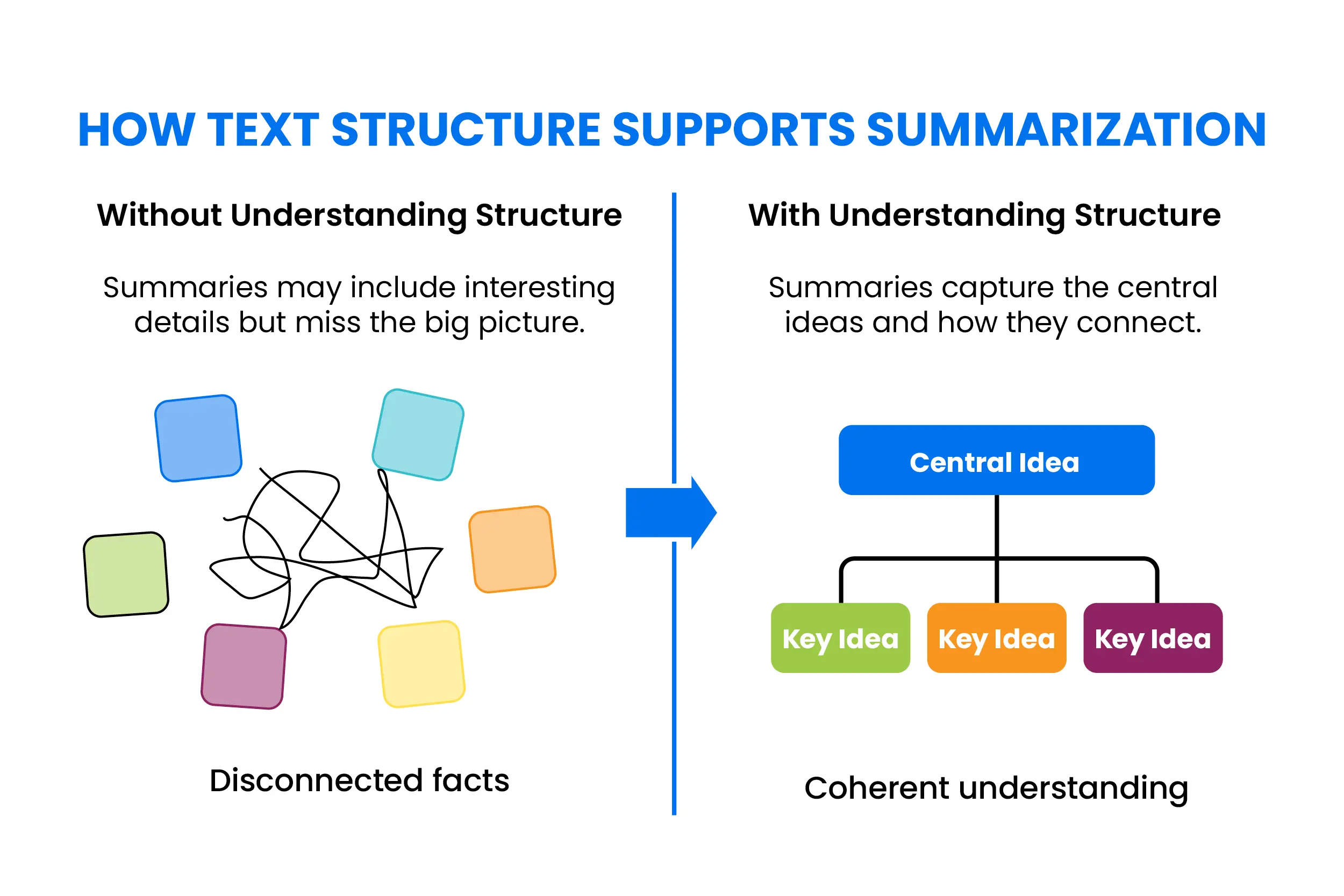
Research studies have found that text structure instruction can positively impact students' reading comprehension because it supports their ability to write or create better summaries of the text.
To effectively create a summary, students need to be able to distinguish between the main idea of a text and the supporting details, synthesize the important ideas, and then express that information in their own words.
Students who lack the ability to understand the way a text is organized are more likely to create summaries that consist of disconnected facts, without a connective throughline. They may include too many unimportant details or fail to identify the bigger picture.
However, when students are able to utilize text structure as a scaffold for summarization, they become much more successful in identifying overarching ideas, making connections and then communicating their interpretation of the author’s message more effectively.
Being able to summarize text, both orally and in writing, is important because it is a strong demonstration of whether or not a student understood what they read.
Beyond the Five Common Types of Text Structure
Often when teachers hear the phrase text structure, many immediately think of things like anchor charts featuring the five most common types of text structure.
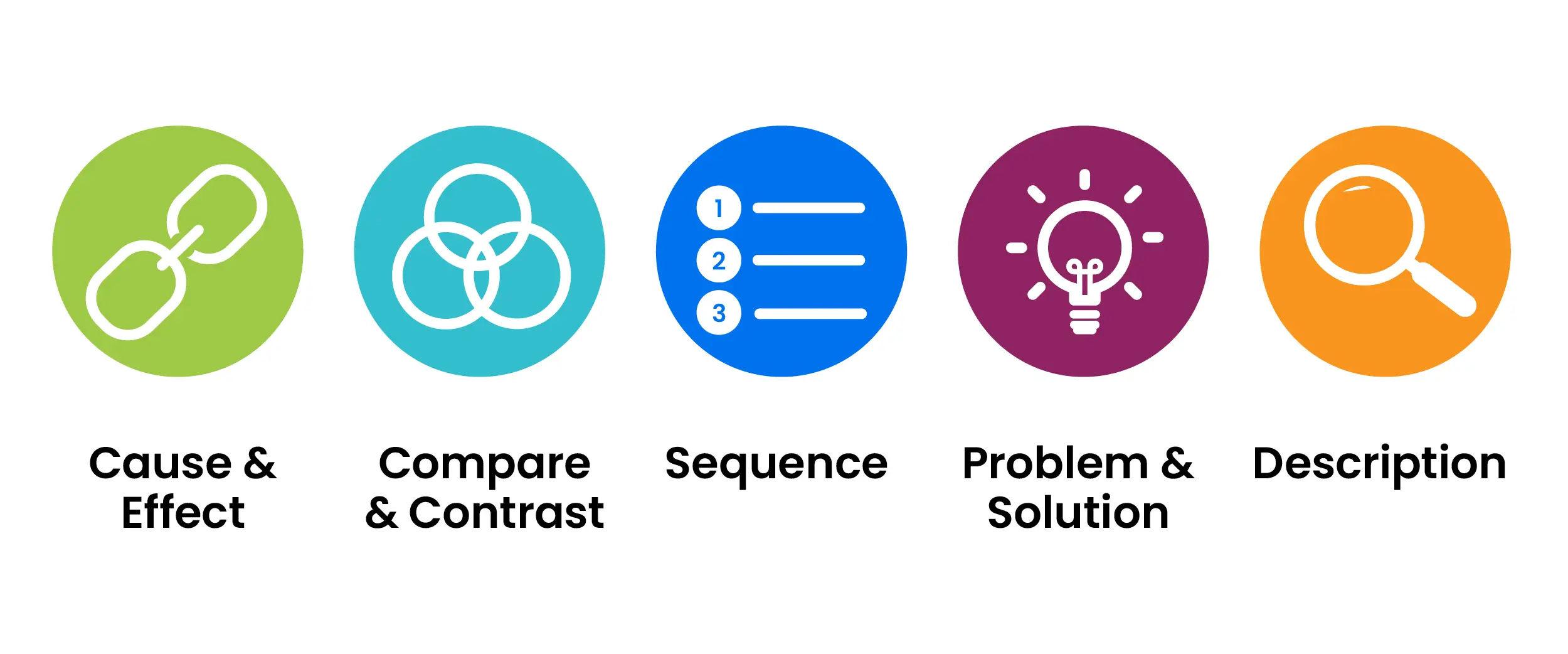
Explicit instruction in these organizational patterns is important because it gives students a foundation for identifying how authors organize ideas. But simply identifying types of text structure is only the beginning.
As students become more proficient readers, they should begin using that knowledge to explain why authors organize ideas in particular ways and how those organizational decisions impact the message of the text.
So what does this look like in practice? Read on to discover a step-by-step process for how to effectively teach text structure explicitly.
A Step-by-Step Process for Teaching Text Structure
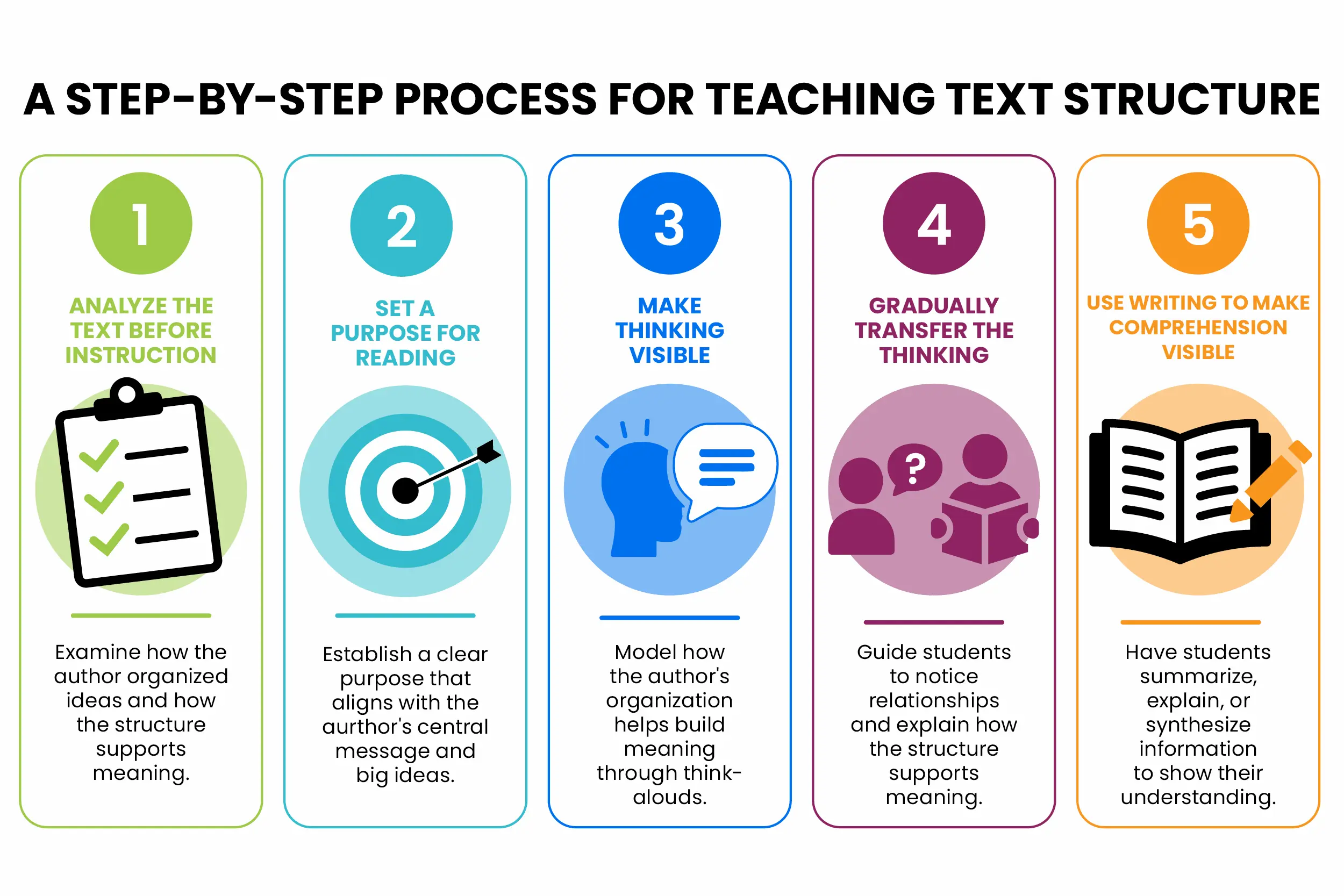
Rather than asking students to simply identify a type of text structure after reading (which is not a very useful outcome), teachers can instead use text structure as a scaffold to support students with meaning-making. Here are five ways to teach text structure to strengthen comprehension.
Step 1: Analyze the Text Before Instruction
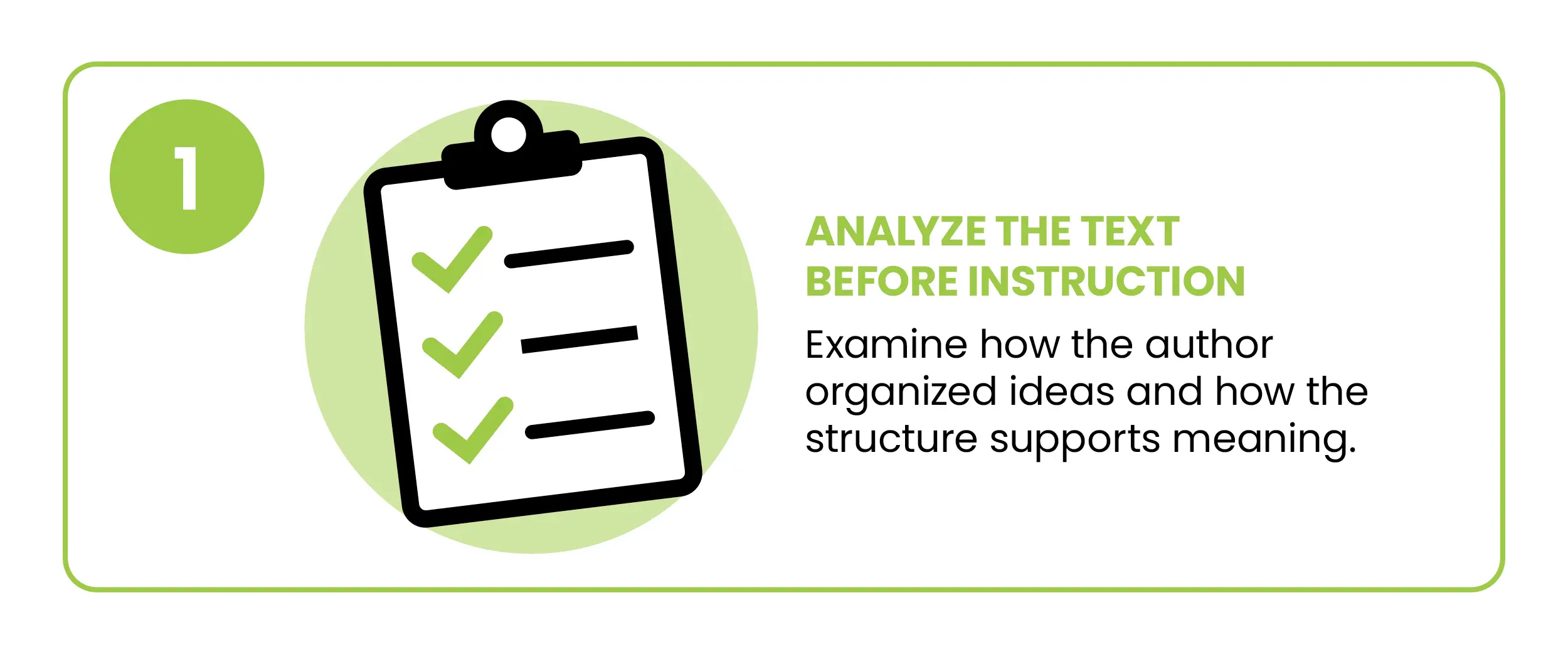
Effective text structure instruction begins before students ever open the text. During lesson planning, teachers should preread the passage and consider how the author's organization supports meaning. Here are some helpful guiding questions:
- How has the author organized the ideas?
- Why might the author have chosen this organization?
- How does the organization support the author's central message?
- Which relationships among ideas are most important for students to notice?
- Where are students most likely to experience misconceptions or breakdowns in understanding?
Consider the following scenario: Imagine you’re a middle school teacher who is planning to introduce an informational text about how pollution has impacted a wetland ecosystem. As you’re prereading the text, you might notice that the author organizes the information by describing a series of events and then discussing how each one changed the ecosystem. Students may be quick to identify the series of events, but not recognize the important cause-and-effect relationships that connect them.
Thinking through these questions ahead of time helps identify and plan for the thinking to model during instruction and anticipate where students may need additional support.
Step 2: Set a Purpose for Reading
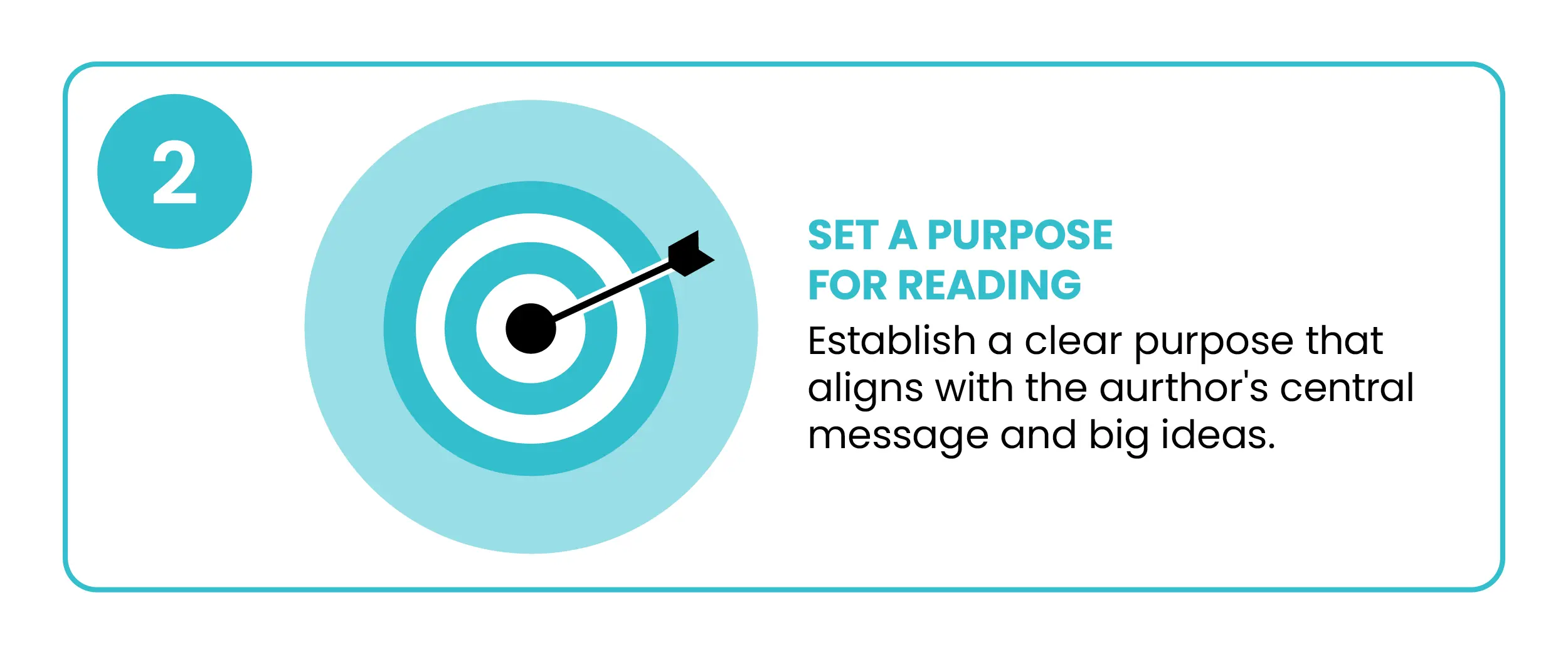
It is critical to set a purpose of reading before engaging students with a piece of complex text. Establishing a clear purpose for reading allows students to focus on the big ideas they’ll be trying to understand. Rather than explicitly stating which text structure they will encounter, direct students toward identifying the author's overarching message.
Tell students: As we read today, think about what caused the wetland ecosystem to change over time. Pay attention to the information the author includes to help us understand those changes.
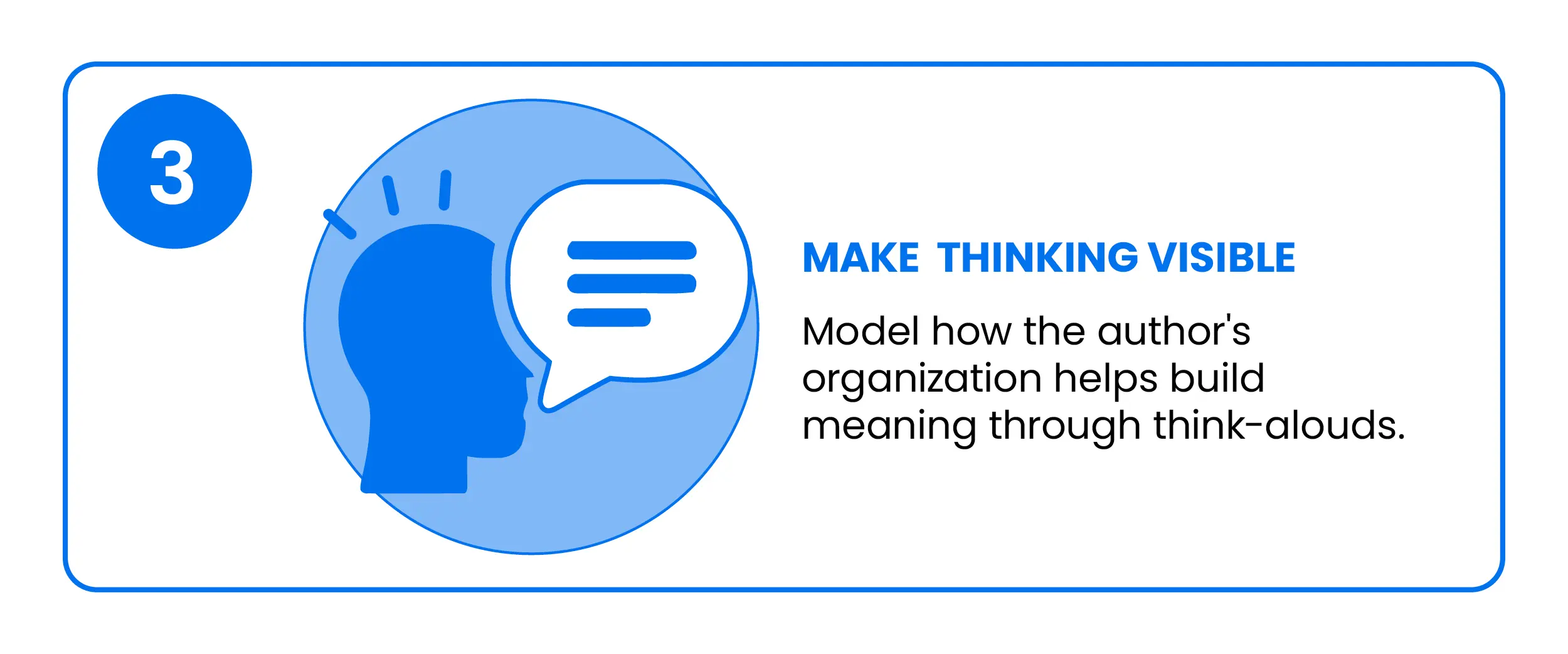
Step 3: Making Thinking Visible
As you read the text with students, stop and use think-alouds to model how to identify and use the author’s organization to construct meaning, instead of just highlighting a single text structure.
Tell students: I'm noticing that the author first describes the factory opening near the wetland and then explains a series of events that happened to the plants and animals afterward. Those ideas aren't just separate facts, they're connected. Understanding those cause-and-effect relationships helps me explain why the ecosystem changed over time.
These think-alouds make the invisible work of comprehension visible and demonstrate that text structure is a tool for understanding, not simply another label to memorize.
Step 4: Gradually Transfer the Thinking to Students
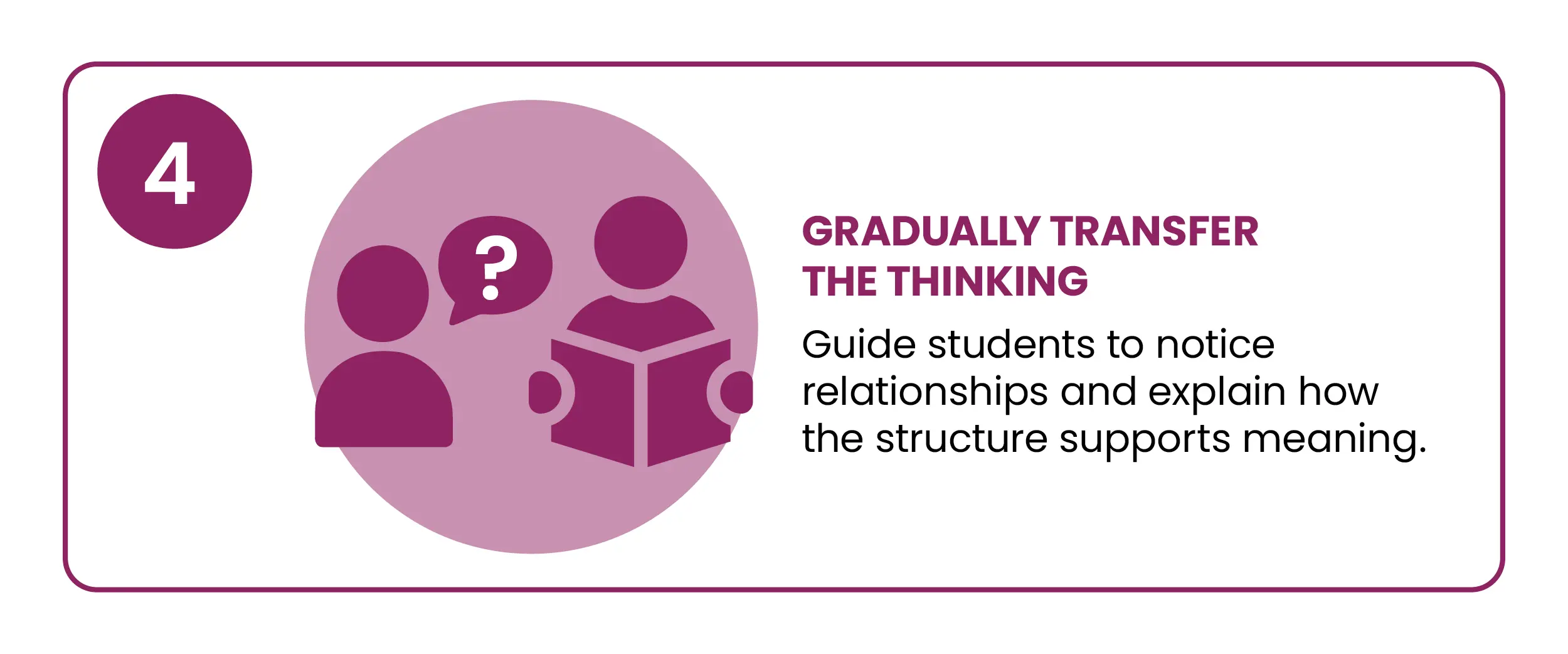
After students have observed your thinking process, you can begin to shift more of the cognitive work to them through the gradual release of responsibility. Continue to pause during reading, but invite students to help identify the organizational relationships present in the text. Continue to scaffold their thinking through purposeful questioning and discussion.
Rather than asking: What type of text structure is this?
Consider asking:
- What relationship is the author helping us notice?
- Why do you think the author organized the ideas this way?
- How does this organization help you better understand the author's message?
Graphic organizers can be especially useful during this stage because they make relationships among ideas visible while students are still developing this way of thinking. It is important that students take an active role in creating or completing the graphic organizers in order for the strategy to positively impact their comprehension.
Step 5: Use Writing to Make Comprehension Visible
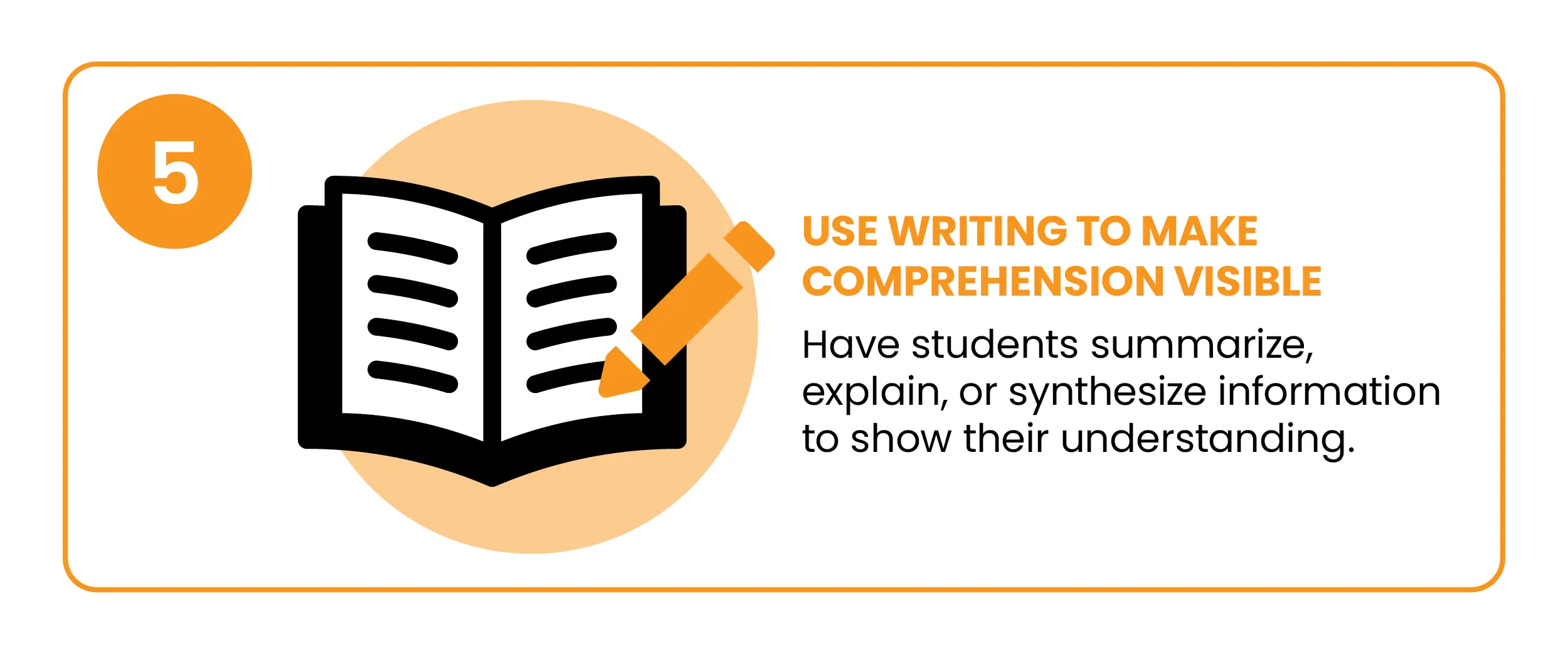
During or after reading, one way for students to demonstrate their understanding of the text is through writing. Short constructed responses or written summaries provide opportunities for students to independently use their text structure knowledge and critical thinking to show what they know.
For example, after reading the article, students might respond to a prompt such as: Explain how pollution changed the wetland ecosystem over time. Use evidence from the text to support your explanation.
A student who understood the text might write: Pollution from the nearby factory contaminated the water, causing many plants to die. As the plants disappeared, animals lost both their food source and habitat, leading to major changes throughout the ecosystem.
Because the student recognized the author's chain of cause-and-effect relationships while reading, their written response reflects a coherent understanding of how the ideas fit together. Responses that consist of disconnected facts or omit important relationships may indicate that students need additional support recognizing how the author utilized text structure to organize the information.
Writing, therefore, gives teachers an opportunity to see whether students understood how the author's organization contributed to its meaning.
Text Structure: A Tool for Comprehension
Ultimately, text structure instruction is valuable because it provides students with a framework for making sense of the many different kinds of texts they will encounter.
Over time, the goal is that students move beyond recognizing how a text is organized to using that organization as a tool for comprehension.
References:
- Bogaerds-Hazenberg, S. T. M., Evers-Vermeul, J., & van den Bergh, H. (2021). A meta-analysis on the effects of text structure instruction on reading comprehension in the upper elementary grades. Reading Research Quarterly, 56(3), 435–462. https://doi.org/10.1002/rrq.311
- BKim, Y.-S. G. (2026). Cultivating the reader and writer: Teaching literacy as an integrated science. Guilford Press.
The Disciplinary Literacy Handbook
Help students read, write, speak, and think across every subject with research-based insights and practical strategies for the classroom.